


Original Post Date: 2025-04-05
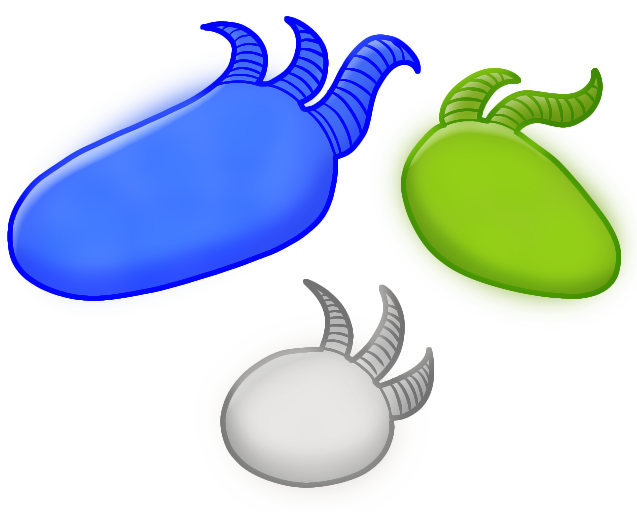
If you’ve noticed a spelling change in the term, that’s simply because I decided to revamp the conlang that the name comes from. (“Igpla” means “mass” by the way. Like “lump”.)
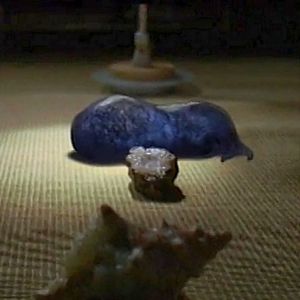
As mentioned in the original post, these guys were inspired by the gelatinous mass from The Last Mimzy.
An igpla (genus Agplis in-universe) is a fictional type of hydrozoan in my books. Hydrozoans are related to jellyfish and coral!
Most hydrozoans are microscopic, but igplas eventually started growing larger and became (typically) about 30 centimetres long. You can see the resemblance to the genus Hydra especially, so I like to think that Hydridae and Agplidae (the fictional taxonomic family where Agplis is) are similar, and maybe share a node on the phylogenetic tree of hydrozoans. Or something. I don’t know, I’m just a science nerd.
I imagine that igplas eat the way bladderwort plants do. Igplas will eat practically anything they can fit inside themselves, but they have a fondness towards eating rocks and crystals. I’m not sure of a good science-accurate reason for this (maybe for digestion like birds?), but this is mostly because it’s a reference to The Blackout Scene™ in Mimzy.
Unlike most hydrazoans, which reproduce through budding, (most kinds of) igplas reproduce through egg-like spores. Igplas don’t have distinct sexes, and are capable of asexual reproduction as well.
(I actually find it amusing that igplas are listed on the Petz wiki Wildz page, since, as stated, igplas aren’t real. However, I do like that I’m the current face of hydrozoan representation in… well, pretty much anything.)
There are seven varieties of igpla:
The rest of the mass varieties (purple, black, white, gold) are mostly just for aesthetics, though I did name them: violaceous, umbriferous, opalescent, and shimmering, respectively. “Umbriferous” suggests that black masses might have something to do with darkness, but besides that, I have no idea what these would do. I may give these their own separate abilities someday.
I forgot to actually bring up why the number of tentacles is relevant to the selin mass! Whoops!
Like all cnidarians, igpla have a polyp stage and a medusa stage. The polyp is the squishy mass body that we get in Petz, but in my books, the medusa stage is a sharp-edged, crown-shaped form called a krikiika ("krikiika" meaning "crown"). The selin mass is the only mass that doesn't become a krikiika, and it's theorized in-universe that it's due to the same divergence that gave it only two tentacles!